Spanish


Magnets are everywhere. Just about anything that uses electricity or a motor has magnets in it. They’re also used in toys, furniture, and even in credit cards. Yet for something so common, magnets still have a way of feeling like magic.
A mysterious force that can push, pull, and levitate objects without touching them? That sounds like a superpower. But as mystifying as it may be, that invisible magnetic force isn’t magic at all–it’s science!
In this guide, we explore the science of magnets for kids! We will explain how magnets work, the different types, and why magnetism is one of the most important forces of nature in both everyday life and our known universe.
Take a Peek at New Exhibits Coming Soon!
The Children’s Museum is currently raising funds for a huge expansion project. Among the new exhibits we have planned is Explora! This interactive space will be dedicated to exploring motion, energy, magnetism, and the unseen forces that shape our universe.
How Do Magnets Work? (Magnetism)
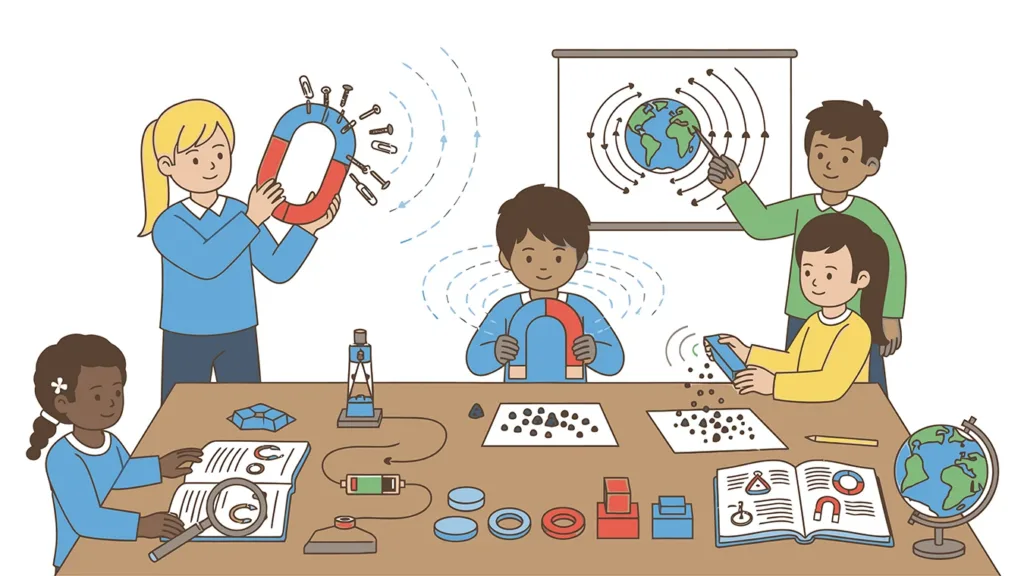
Magnets work through an invisible force called magnetism, which can pull (attract) or push (repel) other magnetic materials without touching them. Not all materials respond to magnets, though. Things like plastic, wood, and glass aren’t affected by magnetism at all.
This is because magnets can only attract objects made out of certain types of metals:
Magnetic Metals
Metals that are magnetic include:
Non-Magnetic Metals
Metals that are not magnetic include:
Magnets can also attract and repel other magnets, depending on which way their magnetic poles are facing.
Magnetic Poles
Every magnet has two ends called poles: a north pole and a south pole. When you bring two magnets close together, the poles determine how they behave.
In the world of magnetism, opposites attract: Opposite poles attract each other (north pulls south), while the same poles repel each other (north pushes north, and south pushes south).
This means when you bring two magnets together, north and south poles will quickly snap together. However, if you try to bring two north poles or two south poles together, they will push away with a force you can actually feel in your hands.
But where does this invisible force actually come from? Great question!
The Magnetic Field
Every magnet creates a magnetic field, which is an invisible force that stretches all around it. This field is what allows magnets to pull objects toward them or push other magnets away.
Inside every magnet, tiny particles called electrons are spinning in the same direction. This coordinated spinning is what creates the magnetic field.
In most objects, electrons spin in random directions, which cancels out their magnetic effect. But in a magnet, most of the electrons spin in the same direction, creating an invisible magnetic field.
Now, take that same idea of a magnetic field and think bigger–much bigger. Like big enough to surround an entire planet. Because that’s exactly what’s happening right beneath your feet.
Planet Earth is a Giant Magnet!
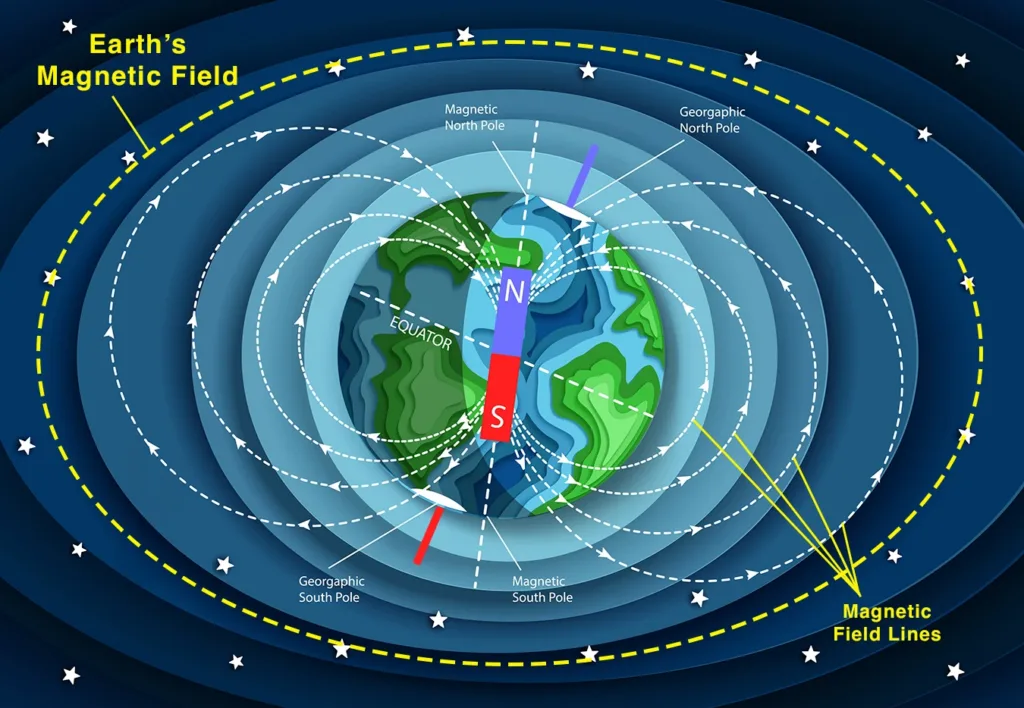
Did you know that you live on a massive magnet? It’s true! Earth acts like a giant magnet, generating a magnetic field in its core. This magnetic field is super important, and without it, we actually couldn’t live on this planet.
Below, we explore what causes Earth’s magnetic field, how it protects us, and the amazing ways we can actually see it in action:
Earth’s Liquid Core
Deep inside the center of Earth is a liquid core made of molten hot iron and nickel. Because our planet is constantly spinning, this hot metal liquid swirls around (like electrons in a magnet), creating a global magnetic field that stretches far out into space.
This invisible magnetic field is called the magnetosphere, and it acts as an invisible shield, protecting all life on Earth!
The Magnetosphere
Earth’s magnetosphere acts as an invisible shield that protects the entire planet from harmful solar radiation. The sun sends out a constant stream of charged particles called solar winds that are harmful to our atmosphere. Earth’s magnetic field deflects the particles away, preventing them from reaching the surface and protecting all life on the planet.
You can actually see this process for yourself. When that solar wind hits Earth’s magnetic field, it creates the Aurora Borealis, also known as the Northern Lights!
The Northern Lights (Aurora Borealis)

The Northern Lights (Aurora Borealis) are a natural phenomenon caused by solar particles colliding with gases in Earth’s magnetosphere. This creates a beautiful dancing light show that is typically visible in the night sky throughout the Northern Hemisphere, including Alaska, Canada, Iceland, and Scandinavia.
This stunning natural light phenomenon is proof that our giant planet-Earth-magnet is working hard to keep us safe.
Earth’s magnetic field is an incredible example of magnetism on a massive scale. But magnets come in many different forms, each with its own unique properties and uses.
Types of Magnets
Not all magnets are the same! In fact, some are natural while others are made by humans and are powerful enough to lift a car. Understanding the differences helps explain how magnets are used in everything from simple toys to complex machines.
Below, we take a closer look at the three main types of magnets and what makes each one unique:
Permanent Magnets

Permanent magnets are exactly what they sound like: magnets that stay magnetic all the time and all on their own. These are what most of us picture when we hear the word “magnet.”
The decorative magnets on your fridge and the classic horseshoe-shaped magnets you see in cartoons are both types of permanent magnets.
They’re made from ferromagnetic metals like iron, nickel, and cobalt, or different mixtures of these metals called alloys.
Temporary Magnets

Temporary magnets are objects that act like magnets, only when they’re near a strong magnetic force. The moment that force is removed, they lose their magnetism almost instantly. Any object made from iron, steel, nickel, or cobalt (magnetic metals) can be temporary magnets when exposed to a magnetic field.
For example, many paper clips are temporary magnets because they are made from steel wire. If you hold a paper clip near a magnet, the paper clip itself becomes temporarily magnetic and can pick up other paper clips below it. Move the magnet away, and the paper clip chain falls apart.
The paper clips go back to being ordinary paper clips, completely unaware of their brief moment of magnetic glory.
Electromagnets

Electromagnets can be extremely powerful, and they work differently from any other type of magnet. Electromagnets are only magnetic when electricity flows through them.
The electrical current “turns on” the magnet, meaning it becomes magnetized. The moment the electrical current stops, the magnetism disappears, and the magnet “turns off.” This on/off capability makes electromagnets incredibly powerful and versatile.
A common example of an electromagnet is the massive cranes they use at junkyards that can pick up entire cars. MRI machines at hospitals are also giant electromagnets. Even the device you’re reading this on right now almost certainly contains an electromagnet somewhere inside it!
How Magnets Are Used in Everyday Life

Magnets are a driving force behind some of the most important discoveries and advancements in human history. In fact, they play an important role in many of the tools, machines, and technologies we use every day. Scientists, doctors, and engineers rely on magnetic forces to solve big problems, build incredible machines, and even explore the farthest reaches of the universe!
Below, we look at some of the most fascinating ways magnets are used in everyday life and why they are so important:
Magnets Play a Major Role in Medicine
Magnets are one of modern medicine’s most valuable tools. One of the most well-known examples is the MRI machine.
MRI stands for Magnetic Resonance Imaging. These machines use powerful electromagnets to take detailed pictures of the inside of the human body. This allows doctors to spot injuries, diseases, and other health conditions.
Magnets are also used in certain medical devices like hearing aids and even pacemakers, which are used for treating certain heart conditions.
Magnets Are How We Generate Electricity
Nearly every power plant on Earth uses magnets to generate the electricity that powers our homes, schools, and cities. This includes all large-scale wind turbines, hydroelectric dams, fossil fuel, and nuclear power plants. They use machines called generators to spin large magnets near coils of wire, which creates an electric current.
This process is called electromagnetic induction and was discovered by the scientist Michael Faraday in the 1800s. Without that discovery, we would have no electrical power grids, no light bulbs, and no way to charge any of the electrical devices we use every day.
Magnets Power Technology
In addition to generating electricity, magnets are also essential for many devices and technologies to work properly. Inside smartphones, computers, televisions, and even drones, magnets help control sound, store data, and move tiny components.
Speakers and headphones use magnets to turn electrical signals into sound waves you can hear. Computer hard drives and credit cards both use magnetic materials to store information digitally.
Magnets help make technology smaller, faster, and more efficient. Without them, many of the devices we use every day wouldn’t exist.
Magnets Make High-Speed Trains Possible
Some of the fastest trains in the world use magnets to move without even touching the tracks. These are called maglev trains, short for magnetic levitation trains, and instead of rolling on a track, they actually float above it!
Maglev trains use powerful magnets to lift the train slightly above the guideway and propel it forward. Because there is no friction from the wheels, these trains can move much more smoothly and reach speeds of over 300 miles per hour. These high-speed trains are also quieter and require less maintenance than traditional trains.
Countries like Japan and China have built impressive maglev train systems that are transforming how people travel, making it faster, smoother, and more efficient than ever before.
Magnets Help Us Explore the World
Magnets also play a crucial role in how we navigate and explore the world around us. Compasses use Earth’s magnetic field to point north, helping people navigate on land, in the air, and at sea without getting lost.
Scientists use magnetic sensors to map the ocean floor, study climate patterns, track tectonic plate movement, monitor volcanic activity, and more.
Even some animals use magnetism! Sea turtles, salmon, and some species of birds can sense Earth’s magnetic field and use it like a natural GPS to migrate thousands of miles every year.
Magnets Help Us Explore Outer Space
Magnets are just as important in outer space as they are here on Earth. Many spacecrafts and satellites use magnetic systems for navigation, communication, and scientific research.
Scientists at NASA and other space agencies study the magnetic fields of other planets, moons, and stars to learn about them.
Astronauts aboard the International Space Station (ISS) use magnets to help keep tools, equipment, and even food trays from floating away.
From hanging artwork on your fridge to powering entire cities, magnets play a big role in everyday life. Learning about magnetism can help kids see science in action all around us, every single day, while building curiosity about how the world works.
Help Us Inspire the Next Generation of Scientists!
At the Children’s Museum of Sonoma County, our interactive exhibits and educational programs are designed to provide hands-on learning opportunities for children of all ages. We believe there is no better way for young minds to fall in love with learning than through play-based discovery, exploration, and fun!
But we need your help. We have a bold vision for the future of the Children’s Museum and are currently raising funds for a huge expansion project. We want to create a bigger space where even more children can learn, explore, and discover.
Among the new exhibits we have planned is Explora! This interactive space will be dedicated to exploring motion, energy, magnetism, and the unseen forces that shape our universe.
This campaign is large, ambitious, and deeply important. Help us inspire the next generation of scientists, engineers, and inventors. Every gift moves us closer to our goal.
Donate today and help make it happen.